
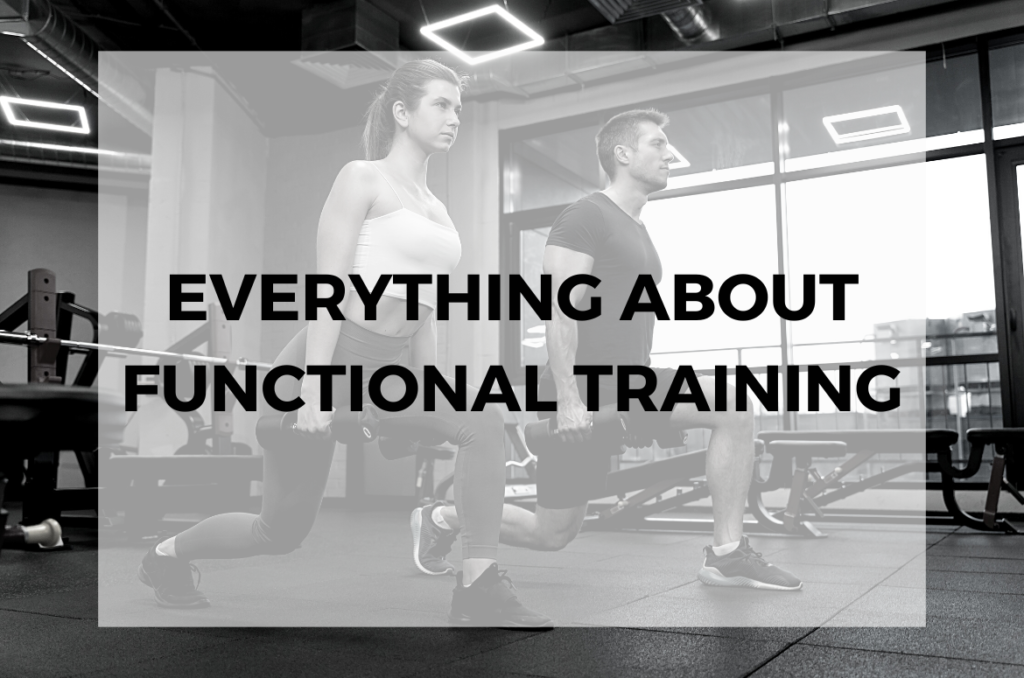
Functional training exploded onto the scene 20 years ago, yet the term is still used to describe just about any training that is not bodybuilding. This Blog lays the groundwork for this training method by providing basic definitions and applied concepts. The applied approach taken in this blog will enhance your understanding of what functional training is and how to use it to enhance performance.
WHY FUNCTIONAL TRAINING?
Functional training has become a hot topic and a popular training approach. In spite of a lack of specific research or clear definitions and a fair amount of controversy surrounding its methods, functional training is everywhere. Dozens of books & blogs have been written on the topic, and you can’t attend a fitness conference or go to a sport training camp without seeing the functional training revolution. So, what makes this training method so effective and popular? The answers are simple, as we’ll discuss in this blog.
- Little Space, Little Equipment, and Little Time
Nearly any traditional gym features thousands of square feet filled with hundreds of pieces of equipment that cost hundreds of thousands of dollars. In stark contrast, functional training gyms have lots of room with only some basic equipment around the perimeter. Functional training is about movement, not equipment. Therefore, a set of dumbbells, some medicine balls, a few hurdles, some bands, and a few stability balls can allow anyone to turn a room, a parking lot, or an athletic field into a functional training area. The low cost of equipment is another major advantage of functional training. With a few hundred dollars and a duffle bag, a coach can train a single athlete or an entire group anywhere, anytime. Time is as scarce as money these days; everyone has busy schedules filled with responsibilities. Therefore, being able to train anywhere and at any time allows the group and coach to be effective where many can’t. Functional training circuits are extremely effective in keeping an athlete or a group in tip-top shape, especially while traveling. For example, you can take the 15 to 40 minutes spent traveling to and from a training facility and spend it training anywhere. You can perform 15- to 20-minute individual and team workouts in a parking lot, dorm hallway, gymnasium, or hotel room at any time of day or night.
- Strength Without Size
A great characteristic of neuromuscular adaptation is that you can get stronger without getting bigger or heavier. This is a huge advantage for athletes who are in weight-class sports or sports where weight gain may create a disadvantage. The coordination between muscles and muscle systems also allows the body to spread the load through multiple muscle systems. This distribution of work creates less stress on any one muscle, reducing the need for a specific muscle to adapt and get bigger. With functional training, no single muscle screams; instead the entire body sings. That is the essence of athleticism.
- Performance Benefits
Considering the benefits of functional training as well as its specificity-driven philosophy, it doesn’t take a vivid imagination to figure out its performance benefits. Functional training can focus on and improve any sport skill. The single-leg exercise that addresses locomotion teaches the hamstrings and glutes to extend the hips and stabilize the body, increasing running speed, boosting cutting ability in field sports, and improving single-leg jumping in court sports. The level-change exercises that target jumping and lifting improve two-leg vertical jump height as well as lifting mechanics. The pushing and pulling exercises enhance punching, pushing, swimming, and throwing. Finally, the rotational exercises improve swinging, changes of direction, and rotational power generation.
Myths About Functional Training
Part of the controversy and confusion surrounding functional training is due to the misrepresentation of what functional training is. There is a fine line between an exercise that is effective and an exercise that is optimal, and we need to keep our terminology consistent. At the end of the day, the principle of specificity allows us to figure out what functional training is and what it isn’t. Let’s go through a few of the concepts that have been misrepresented during the evolution of functional training.
- Effective Versus Optimal
To simplify the concept of functional training, we must first note the difference between effective training and optimal (functional) training. Training can be effective without having optimal transfer (i.e., without being functional). For example, a novice basketball player can use knee extensions and leg curls to improve running and jumping to some degree. These two traditional exercises may be effective in enhancing the athlete’s general strength needed in running and jumping, but they will not be as effective as single-leg exercises used in more comprehensive and progressive training model, such as a three-stage developmental training model that in progressively develops general, special, and specific strength. For example, if a running athlete was going to organize the training in a progressive, three-stage fashion, general strength is usually developed by traditional strength exercises, such as squats, leg presses, and power cleans. Special strength is oftentimes developed by functional exercises that more closely resemble the target activity, such as single-leg anterior reaches, single-leg squats, and single-leg stability ball bridges. Specific strength can then be developed by resisted running drills, uphill runs, and other forms of resisted running. Although this is an over simplification of the three-stage model, it provides an illustrative view of how the training becomes more specific or functional as time progresses. Functional training is driven by the concept of specificity. Single-leg exercises are more specific to running and jumping off a single leg than two-leg exercises, and therefore they are functional for any single-leg activity, such as a basketball player cutting and coming off a single leg for a layup.
- Not All Proprioception Is Created Equal
A big word making its way into the mainstream is proprioception, or how body reads information from various body parts as well as the environment. This information (i.e., proprioceptive feedback) is the language the nervous system uses to figure out what is happening with the body and what move to make next. Functional training is thought to produce more proprioceptive feedback (i.e., meaningful information) than bodybuilding exercises do. For example, the leg curl uses a seated position and a fixed pattern of movement; not a lot of information is needed to execute the exercise. On the other hand, its functional counterpart, the reaching lunge, requires more coordination between the big muscle systems on the posterior aspect of the hips and uses the related muscle groups in a way that is more consistent with the running motion (i.e., teaching the hamstrings to extend the hips while controlling knee flexion). This complex coordination requires more proprioceptive feedback between the muscular system and the central nervous system. Thus, the leg curl machine is less proprioceptively enriching than the reaching lunge is because the leg curl machine stabilizes the movement and requires less proprioceptive feedback than the reaching lunge, which is not stabilized by any exterior mechanism. Coincidently, this is where the concept of unstabilized training, or stability training, comes from; the reaching lunge occurs in an unstabilized environment, requiring the body to develop the stability in order to execute the movement correctly. Just because a high amount of neural information (proprioception) is being processed, it does not mean the information is meaningful. The neural language of functional training must be specific to the athletic skill being targeted. If an athletic skill requires the transfer of high forces from the ground to an implement (e.g., a bat) through stiff body segments, then that proprioceptive language must be part of the functional training to improve performance.
- Balance Versus Stability
Balance training should not be confused with stability training. Unstable training environments are one of the hottest topics in functional training. For this reason we will cover this topic a bit more comprehensively than the others. Let’s start with some definitions and then take the discussion from there. As a noun, balance means the stability produced by the even distribution of weight on each side of the vertical axis. As a verb, it means to bring about a state of equilibrium (a state of balance between opposing forces).
Stability is the quality, state, or degree of being stable, as in the following:
- The strength to stand or endure; firmness
- The property of a body that causes it when disturbed from a condition of equilibrium or steady motion to develop forces or moments that restore the original condition
- Equipoise between contrasting, opposing, or interacting elements to resist forces tending to cause motion or change of motion
- Designed so as to develop forces that restore the original condition when disturbed from a condition of equilibrium.
In practical terms, balance is the act of manipulating opposing forces to create a stable state over a base of support. Stability is the control of unwanted motion to restore or maintain a position. Balance usually requires the transfer of low forces to maintain equilibrium, whereas stability usually requires the transfer of high forces to create rigidity. The best visual example of stability and balance is a pyramid (figure). As you can see, the stable pyramid can withstand any force driven through its system; it is both strong and balanced. The balanced pyramid can’t take any force except one going through its vertical axis. If you think of the body as an organic pyramid that responds to progressive multidirectional loading by getting bigger and better at maintaining stability, then you must train it while it is on its base and not its point. When the pyramid is balancing on its point, you simply cannot load it enough to create any significant adaptation. There is nothing you can do from an unstable balanced position (e.g., one-leg balance) except stand there, balance, and wait to be pushed over by a fast-moving object. Athletes cannot transfer high forces or maintain their position in the face of hard physical contact from a narrow or small base of support; they are at the mercy of the physical forces of the environment (e.g., another athlete making physical contact). This is especially true during static conditions where athletes can’t use momentum and inertia to help maintain dynamic control. Functional training must concentrate on creating stability (i.e., super stiffness) so that proper athletic positions can be maintained and forces can be transferred through the kinetic chain. This means it must train the core in a stable state to be as stiff (rigid) as possible first and then let it move as it needs to.